Thursday, 26 January 2012

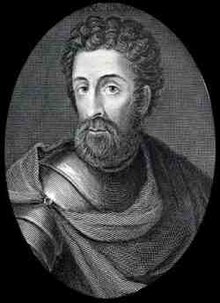
Sir William Wallace


Sir William Wallace (Medieval Gaelic: Uilliam Uallas; modern Scottish Gaelic: Uilleam Uallas; Latin: Guillelmum le Walois de Scotia militem; died 23 August 1305) was a Scottish knight and landowner who became one of the main leaders during the Wars of Scottish Independence.
Along with Andrew Moray, Wallace defeated an English army at the Battle of Stirling Bridge in 1297, and was Guardian of Scotland, serving until his defeat at the Battle of Falkirk. In 1305, Wallace was captured in Robroyston near Glasgow and handed over to King Edward I of England, who had him hanged, drawn, and quartered for high treason and crimes against English civilians.
Since his death, Wallace has obtained an iconic status far beyond his homeland. He is the protagonist of the 15th century epic poem The Acts and Deeds of Sir William Wallace, Knight of Elderslie, by Blind Harry. Wallace is also the subject of literary works by Sir Walter Scott and Jane Porter and the Academy Award winning epic film, Braveheart.

Background

Although he was a minor member of the Scottish nobility, little is known for certain of William Wallace's family history. Records show early members of the family as holding estates at Riccarton, Tarbolton, and Auchincruive in Kyle, and Stenton in Haddingtonshire.They were vassals of James Stewart, 5th High Steward of Scotland as their lands fell within his territory. It is believed by many historians that William Wallace's possible ancestor Richard Wallace (a Norman-Breton knight) came to Scotland in the 1130s in the service of Walter Fitz Alan who had been appointed Stewart by King David I and settled in Ayrshire. There are several Ayrshire Wallace seals attached to the Ragman Rolls, but none of them display a lion (the traditional arms associated with Wallace) — using rather a saltire, a cross patty and a fleur-de-lis.
William Wallace was probably descended from one of Richard's sons who married into local Scottish land-owing families. Hence Wallace and his Scoto-Norman ancestors would have been well acquainted with Gaelic, French, Latin, Greek, and possibly an early form of Scots.
Some sources give the name of William Wallace's father as Malcolm Wallace, but the seal attached to a letter sent to the Hanse city of Lübeck in 1297 appears to give his father's name as Alan.His brothers Malcolm and John are known from other sources. An Alan Wallace appears in the Ragman Rolls as a crown tenant in Ayrshire, but there is no additional confirmation.The traditional view regards Wallace's birthplace as Elderslie in Renfrewshire, and this is still the view of most historians,but there have been recent claims[by whom?] that he came from Ellerslie in Ayrshire. There is no contemporary evidence linking him with either location, although both areas had connections with the wider Wallace family.
Wallace's year of birth can only be guessed at, although he was probably a relatively young man at the time of his military exploits and death. It is not known if he was ever married, or if he had any children.

Sunday, 22 January 2012

George Washington


George Washington (February 22, 1732 [O.S. February 11, 1731] – December 14, 1799) was the first President of the United States of America, serving from 1789 to 1797, and dominant military and political leader of the United States from 1775 to 1799. He led the American victory over Great Britain in the American Revolutionary War as commander-in-chief of the Continental Army from 1775 to 1783, and presided over the writing of the Constitution in 1787. Washington became the first president by unanimous choice, and oversaw the creation of a strong, well-financed national government that maintained neutrality in the wars raging in Europe, suppressed rebellion and won acceptance among Americans of all types. His leadership style established many forms and rituals of government that have been used since, such as using a cabinet system and delivering an inaugural address. Washington is universally regarded as the "Father of his country".
Washington was born into the provincial gentry of a wealthy, well-connected Colonial Virginia family who owned tobacco plantations and slaves. After both his father and older brother died young, Washington became personally and professionally attached to the powerful William Fairfax, who promoted his career as a surveyor and soldier. Washington quickly became a senior officer in the colonial forces during the first stages of the French and Indian War. Chosen by the Second Continental Congress in 1775 to be commander-in-chief of the Continental Army in the American Revolution, Washington managed to force the British out of Boston in 1776, but was defeated and almost captured later that year when he lost New York City. After crossing the Delaware River in the dead of winter, he defeated the British in two battles, retook New Jersey and restored momentum to the Patriot cause. Because of his strategy, Revolutionary forces captured two major British armies at Saratoga in 1777 and Yorktown in 1781. Historians laud Washington for his selection and supervision of his generals, encouragement of morale and ability to hold together the arm, coordination with the state governors and state militia units, relations with Congress and attention to supplies, logistics, and training. In battle, however, Washington was repeatedly outmaneuvered by British generals with larger armies. After victory had been finalized in 1783, Washington resigned rather than seize power, proving his opposition to dictatorship and his commitment to American republicanism. He retired from the presidency in 1797 and returned to his home, Mount Vernon, and his domestic life where he managed a variety of enterprises. He freed all his slaves by his final 1799 will.
Dissatisfied with the weaknesses of Articles of Confederation, in 1787 Washington presided over the Constitutional Convention that drafted the United States Constitution. Elected as the first President of the United States in 1789, he attempted to bring rival factions together to unify the nation. He supported Alexander Hamilton's programs to pay off all state and national debt, to implement an effective tax system and to create a national bank (despite opposition from Thomas Jefferson). Washington proclaimed the U.S. neutral in the wars raging in Europe after 1793. He avoided war with Great Britain and guaranteed a decade of peace and profitable trade by securing the Jay Treaty in 1795, despite intense opposition from the Jeffersonians. Although never officially joining the Federalist Party, he supported its programs. Washington's "Farewell Address" was an influential primer on republican virtue and a warning against partisanship, sectionalism, and involvement in foreign wars.
Washington had a vision of a great and powerful nation that would be built on republican lines using federal power. He sought to use the national government to preserve liberty, improve infrastructure, open the western lands, promote commerce, found a permanent capital, reduce regional tensions and promote a spirit of American nationalism.[1] At his death, Washington was hailed as "first in war, first in peace, and first in the hearts of his countrymen".[2] The Federalists made him the symbol of their party but for many years, the Jeffersonians continued to distrust his influence and delayed building the Washington Monument. As the leader of the first successful revolution against a colonial empire in world history, Washington became an international icon for liberation and nationalism, especially in France and Latin America.[3] He is consistently ranked among the top three presidents of the United States, according to polls of both scholars and the general public.